Grade in
Cinematography
Grade in
Cinematography
Specialized Degree in Film
Specialized Degree in Film
Duration
Three Academic Years
From October 2026 to June 2029
Home
5 2026 October
Opening hours
Mornings from 9am to 15pm
12 hours of classes + practical sessions + filming
The place where your passion for film becomes a profession
Three years of comprehensive training where you'll learn by doing, from day one, with a camera in your hands. The Film Studies Degree at Bande à Part combines a solid foundation in film language, technique, and history with over 200 academic shoots per year, because we believe the only way to learn filmmaking is by making films. The streets of Barcelona are our studio, the set is your classroom, and every project is an opportunity to discover your place in the industry.
At the end of the degree, you will not only have a portfolio of practical work: you will have a creative identity, a specialization and the necessary tools to make the leap to professional cinema with a firm step.
Degree in Cinematography
Submit dossier a:
You learn to drive by driving.
Bande à Part: The Barcelona school that films the most

Filming is our way of teaching
Because applying what you learn in practice makes your creativity grow. Because you'll find your place in filmmaking by shooting. Because we want you to feel like a natural when you arrive on a professional film set. Because directing actors, operating the camera, managing time pressure, and working as part of a team will become second nature to you. Because the film set will be your natural habitat.

More than 200 Academic Filmings per Year
This isn't just a random number; it's our reality. At Bande à Part, there's always a camera rolling, a set built, and a crew filming. The streets of the Sants neighborhood and every corner of Barcelona are our film set, and according to the Catalunya Film Commission, we're the Barcelona film school that requests the most filming permits.

Equipment and spaces at your disposal
Your creativity knows no schedule. That's why you can use the School's technical equipment to film your personal projects outside of class hours. Need a set for a short film? A space for a casting call? Camera tests? Our School is always active; you can reserve spaces to practice, rehearse, and shape your own films.
At Bande à Part, the day-to-day is a vibrant flow of professional processes, your center of filmmaking.
Students in action
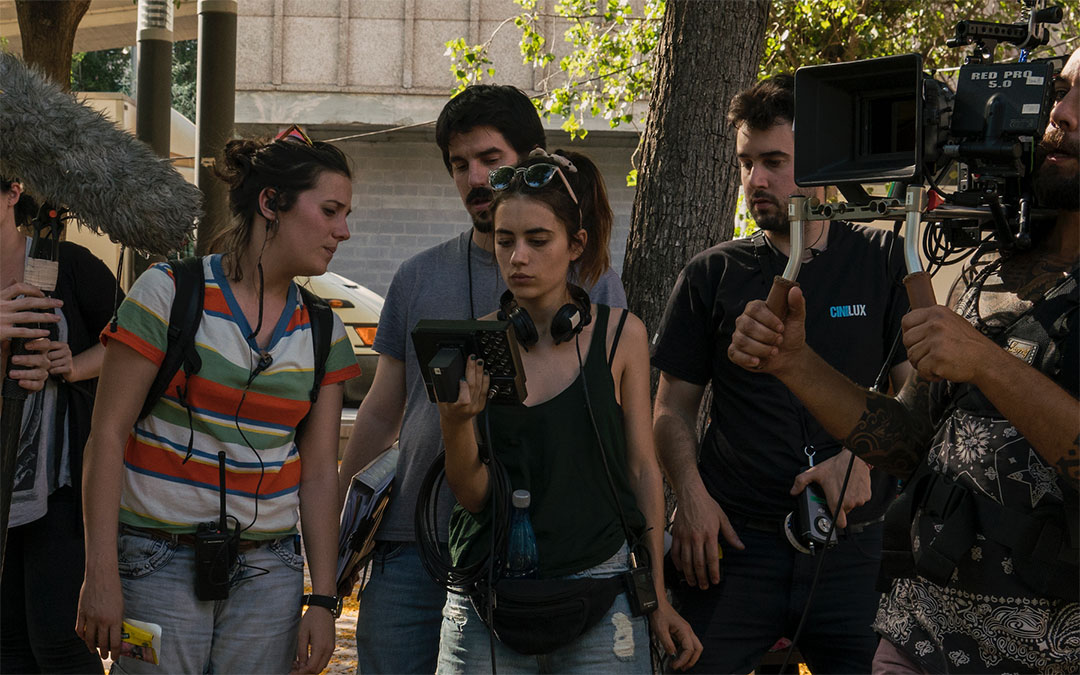
Silence. Camera. Sound. Action. This is what our students experience every day in the classrooms and on the film sets at Bande à Part. This is how we teach filmmaking: by doing it.
The Set as an artistic laboratory
Practice is the necessary means for creativity to be expressed.
At Bande à Part, the day-to-day is a vibrant flow of professional processes, your center of filmmaking.

The artistic approach
as a distinctive touch
Our degree program not only trains impeccable technicians, it trains authors capable of seeing where others only see.

Develop
a voice of one's own
Analysis and introspection to create a unique creative identity. Don't settle for being a replica, become a complete filmmaker.

Critical thinking
before the image
Comprehensive humanistic training and analysis of cinema as a tool for thinking and creating ethical films.

Creativity
applied
Artistic training is not an abstraction; it is a practical tool that you can hone through daily work and on the film set.

Innovate
under pressure
Finding aesthetic and narrative solutions in the face of unforeseen events or a lack of budgets.

Vision
comprehensive aesthetics
Applying language as an emotional grammar capable of communicating powerful ideas.
Upon graduation, our students not only possess a portfolio of practical work, but also a creative personality that sets them apart in the job market. They are professionals capable of leading projects, contributing an original vision, and transforming any commission into a meaningful work of art.

The Degree in 3 years
Initial Cycle: 1st and 2nd Year
Welcome to the Initial Cycle of our Film Program! Get ready for a total immersion in a world full of creativity, passion, and emotion!
The first two years of the degree form a cross-disciplinary path through all the disciplines of film: Cinematographic Language, Camera, Lighting, Screenwriting, Editing, Sound, Film History…. You will learn the technical and narrative fundamentals you need to be a filmmaker.
From day one, you'll shoot your own films and practice all the on-set trades, rotating through every department. Through constant creation and filmmaking as the central focus, you'll transform your passion into a methodology and become a versatile and resourceful professional capable of tackling any creative challenge.
First course
Second course
practical projects
Throughout the two courses you will more than 200 shoots specialized:
- Framing, Lighting and Camera Movement Projects
- Remake of classic sequences
- Western short films
- Projects focused on Sound and Space
- Filming on a set
Each project will allow you to rotate through all the trades: directing, screenwriting, photography, camera, sound, editing, production and art.
Because to find your calling, you must first experiment with everything.
3rd Specialization Course
After the two years of common training, the third year is the time to choose the discipline in which you wish to specialize in order to project your professional career:
- Film Direction and Screenwriting
- Cinematography and Camera Direction
- Film Editing, Post-Production and Sound
At this stage, learning becomes fully immersive. You will focus on perfecting your skills and take on roles of maximum responsibility on large-scale shoots under professional quality standards. This concentration of creativity and technique, combined with your own real of jobs, will guarantee that your leap into the film industry is solid, competitive and distinctive.
Success Story
Gemma Blasco
Our alumni Gemma Blanco has won the Gaudí Award for Best New Director with his impactful film The FuryThis recognition is the fruit of years of dedication and passion for cinema that we saw born in our School. And the story continues, because it is also nominated for the Goya Awards in the same category. Seeing our graduates leading the current film landscape is our greatest reward. Congratulations to Gemma and the entire team! The FuryWith talent and effort, cinema has no limits!
Bàp Teachers
Our professors don't just teach film: they're actively working in the industry. They are directors, screenwriters, cinematographers, and editors who bring real-world industry experience and the personal touch of those who know exactly what it's like to learn to the classroom.
Contact Bàp
We help you decide the course that best suits you